
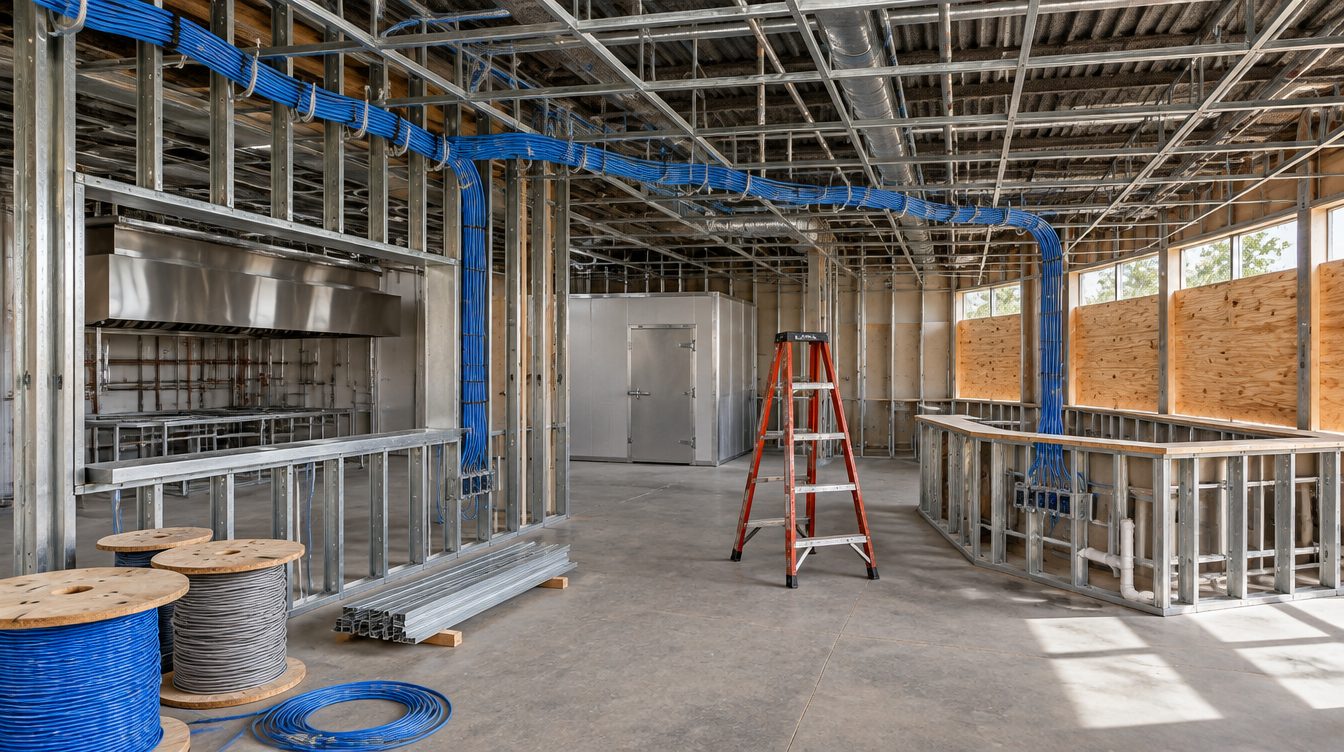
For a Seattle restaurant, a security camera system is built around the spots where money, stock and staff move: the front entrance, the registers, the bar, the alley or service door used for deliveries, and dry storage. Camera cable goes in with the rest of the buildout, recording happens on a unit inside the locked rack with battery backup, and the system and its video belong to the restaurant.
Last updated: November 2026
What each camera is pointed at
- Entrance and host podium: a clear look at faces walking in and out.
- Registers and the bar top: the till and the counter surface, angled so no view can read a PIN being typed.
- Service door and delivery route: the alley entry and the hallway toward the stockroom.
- Stockroom and office: shelving, cases and the safe.
- Not in restrooms or changing areas. Staff break and changing rooms are left off the camera plan entirely.
Microphones off, because Washington requires everyone's consent
Many cameras sold today ship with audio turned on. The rule below applies except as otherwise provided in its chapter. RCW 9.73.030(1)(b) reaches recording a private conversation by any device designed to record or transmit it, regardless of how the device is powered or actuated, without first obtaining the consent of all the persons engaged in the conversation. A booth, a barstool or the manager's desk can host just that kind of talk. So the microphone is disabled on each camera installed here, and the recorder stores picture without sound.
Reader doors on the same schedule as the cameras
Door access usually goes in beside the cameras, with hardware limits of its own. Seattle Building Code 1010.2.11 permits electric locks on egress doors installed to the conditions in the list that follows; one is that loss of power to the electric locking system automatically unlocks the door, and another is that where panic hardware is required by 1010.2.9, operating that hardware also releases the electric lock. The UPS keeps recording through a power cut; no door lock is wired to it to hold a door shut.
Camera and reader cable is low voltage work like the data runs, so it is covered by the same electrical permit and the same cover inspection described on the structured cabling page.
Drawing the views before the drywall goes up
A camera without a cable is a camera mounted twice, so its line goes in at rough-in while installers are overhead for the data and WiFi drops anyway. Views are marked on the same drawing as outlets and radios, with a mount location, a sketched viewing cone and a note about light. Shooting from the back booths into sunny front glass turns faces into silhouettes, so door views come from an angle or use a wide dynamic range setting. Over the bar, the lens is mounted high to take in the rail and the till without seeing what a guest keys into the reader.
Once each unit is up, its picture is reviewed on the recorder for sharpness, framing and night performance, and reference stills go into the closeout file so a shifted view is easy to spot later.
Where footage is stored and who can see it
Keeping the recorder in the rack, next to the switch and behind a lock, makes it hard to grab during a break-in. Off-site viewing uses the manufacturer's app; the owner holds the master login, and each manager gets a personal account that can be shut off on their last day. Storage length comes down to drive capacity and camera count, and the owner sets the number of days kept before old video is replaced.
Camera questions from Seattle owners
Can the cameras left by the previous tenant stay?
Sometimes. A leftover camera has to show a clean picture, work with a current recorder and run supported firmware. Those that do not are swapped out, leaving the restaurant with a single recorder and a single app. List what is mounted now on the contact page.
Can a camera cover the sidewalk seating?
Yes. An outdoor-rated unit on its own cable can watch the tables and the side entry, with audio disabled as on the indoor cameras.